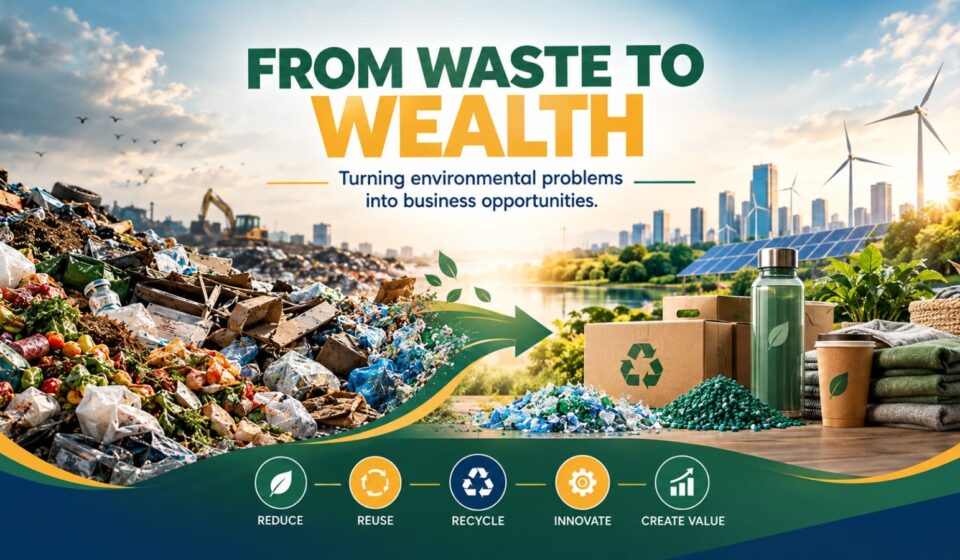
From Waste To Wealth: How sustainable businesses are turning problems into opportunities

What if the waste we throw away every day could actually become valuable?
Every business produces some form of waste. It could be leftover food from a restaurant, excess materials from a factory, unwanted packaging from a supermarket, or old products returned by customers. For many years, businesses have viewed waste as something that simply needs to be thrown away. However, a new approach is changing the way companies think.
Today, more businesses are asking an important question: Can waste become an opportunity? The answer is of course yes.
Sustainable businesses are finding innovative ways to reduce, reuse, recycle and transform waste into useful products and resources. This approach can benefit the environment, but it can also reduce costs, attract customers and create new sources of revenue. This is the idea behind “From Waste to Wealth.”
What does sustainable business mean?
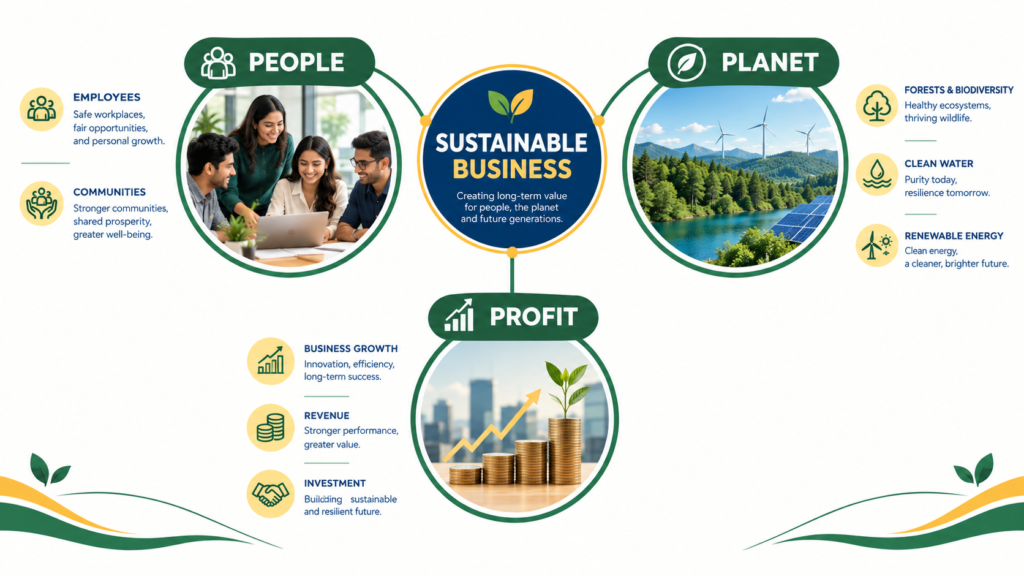
A sustainable business is a business that aims to meet its current needs without damaging the ability of future generations to meet theirs. Traditional businesses may focus mainly on maximising profit. Sustainable businesses still need to make profit, but they also consider their impact on the environment and society.
This is sometimes described using the triple bottom line:
People + Planet + Profit
A successful sustainable business tries to balance all three.
For example, a clothing (SC) company could use recycled materials instead of constantly using new raw materials. A restaurant could donate surplus food instead of throwing it away. A manufacturer could reuse leftover materials rather than sending them to landfill.
These actions can reduce environmental damage while potentially creating financial benefits.
Why Is Waste a Problem?
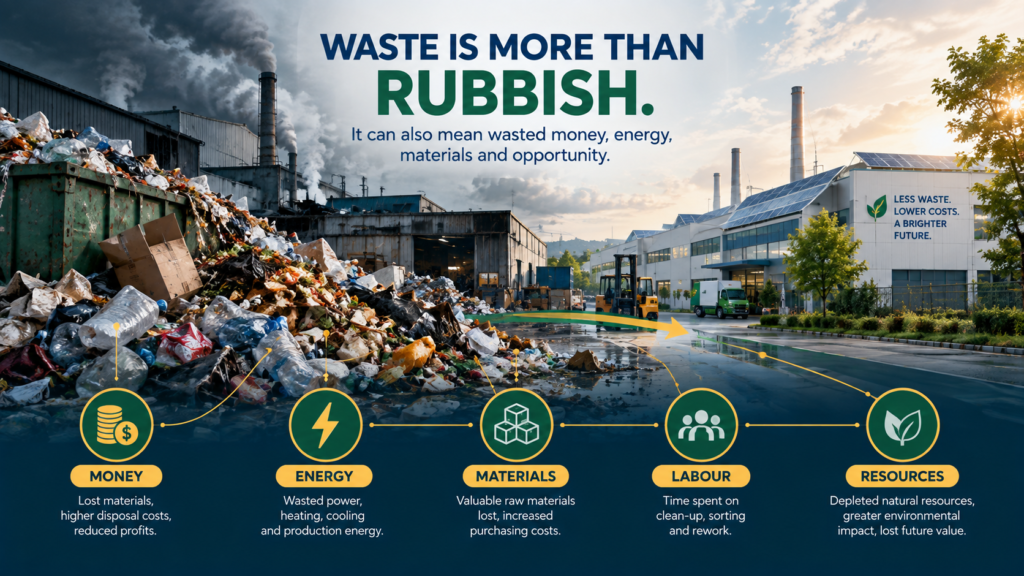
Waste is a major environmental and economic problem.
When businesses throw materials away, they are not only losing the material itself. They may also be wasting the energy, water, labour and money that were used to produce it. Imagine a factory purchasing raw materials worth thousands of pounds. During production, some of these materials are discarded because they are damaged or left over. The business has effectively paid for something that it never sells.
Waste can therefore be viewed as a hidden cost.
There is also an environmental cost. Waste sent to landfill can take a long time to break down, while producing new materials often requires additional energy and natural resources. If businesses can reduce the amount of waste they produce, they can potentially save money while reducing their environmental impact.
The Circular Economy
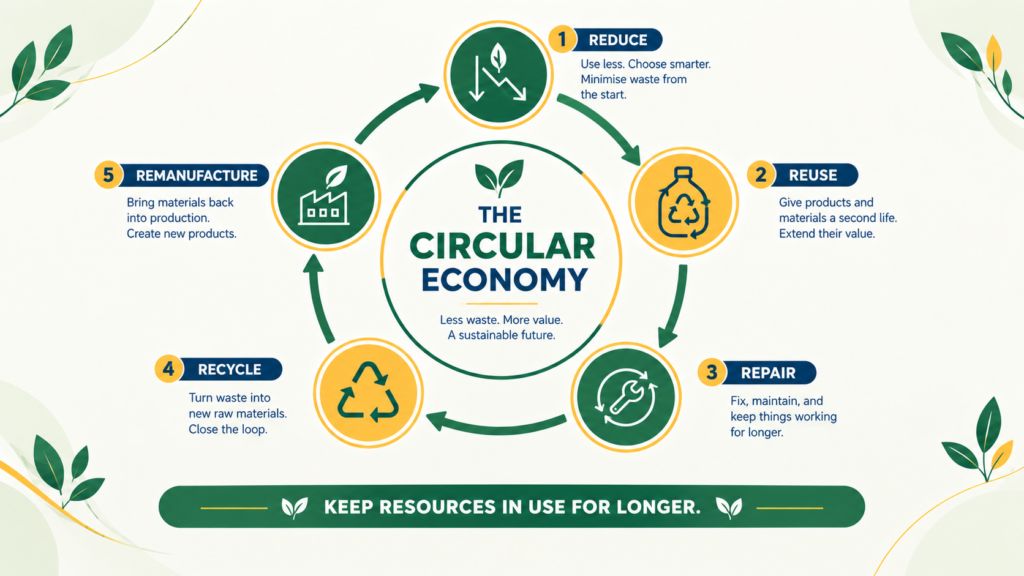
One of the most important ideas behind sustainable business is the circular economy.
In a traditional linear economy, products generally follow this pattern, Take → Make → Use → Throw away. Businesses take raw materials from the environment, turn them into products, sell those products and eventually they become waste.
A circular economy attempts to change this system, Reduce → Reuse → Repair → Recycle → Remanufacture
Instead of throwing products away after they have been used, businesses try to keep materials in circulation for as long as possible.
For example, a furniture company could design a chair that can easily be repaired instead of replaced. A technology company could make devices that are easier to repair or recycle. A clothing company could collect old clothes and use their materials to create new products. The result is less waste and potentially more value from the same resources.
Turning Waste into Products
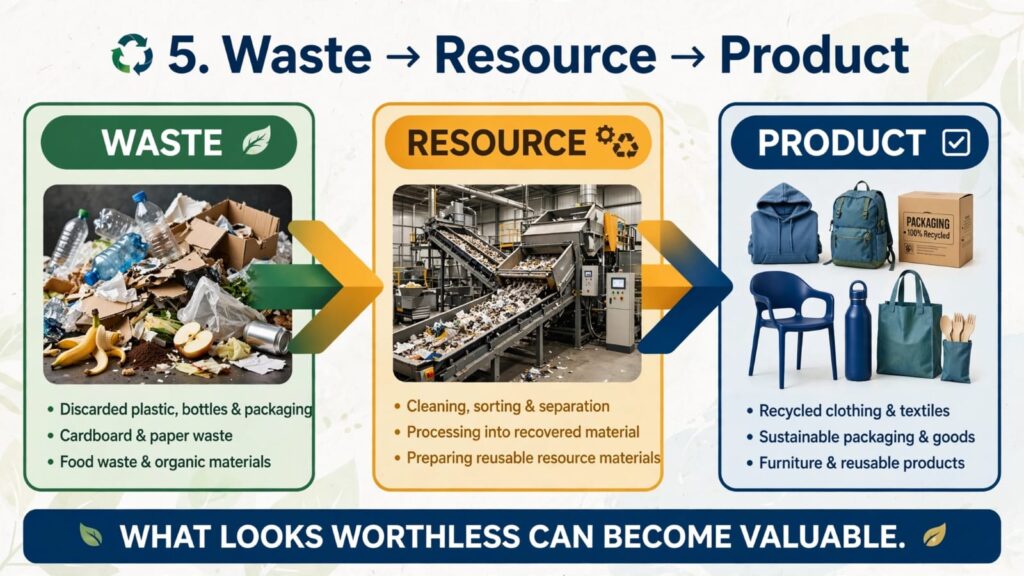
One of the most exciting opportunities is turning waste into something that people are willing to buy.
Consider plastic waste.
Instead of sending used plastic to landfill, companies can collect, process and recycle it into new products. Recycled plastic can be used in packaging, clothing, furniture and many other products. Food waste can also be transformed.
Certain food waste can be converted into animal feed, compost or other useful materials. Businesses can therefore create value from something that was previously considered worthless.
This creates an interesting business opportunity.
Waste is only worthless if nobody can find a useful purpose for it. Entrepreneurs who identify that purpose can create completely new markets.
Saving Money Through Sustainability
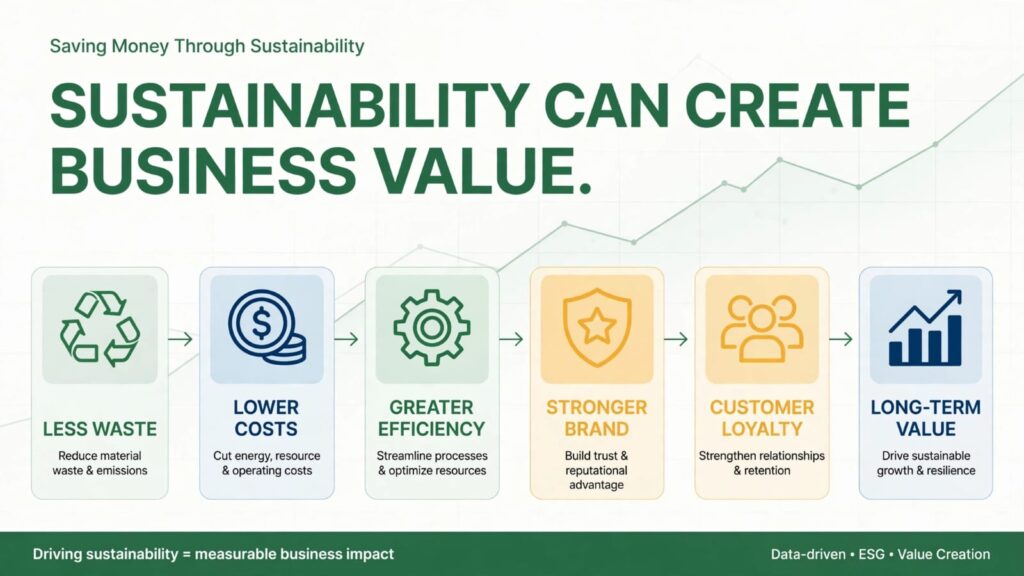
Sustainability is often associated with higher costs. Businesses may have to invest in new technology, sustainable materials or more efficient equipment. However, sustainable practices can also reduce costs in the long term.
Let’s Consider energy,
a business that installs energy-efficient lighting and machinery may have to pay an initial investment. However, using less electricity can reduce its energy bills over time.
The same principle applies to water,
a factory that reduces unnecessary water consumption can lower its water costs
while conserving a valuable natural resource. Waste reduction can also save money because businesses may spend less on purchasing raw materials and disposing of waste. Therefore, sustainability can sometimes be viewed as an investment rather than simply an expense.
Sustainability and Customers
Businesses do not operate in isolation. They depend on customers. Consumer attitudes towards the environment have changed significantly, and many customers now consider how products are made, packaged and disposed of when making purchasing decisions. This creates an opportunity for sustainable businesses.
A company that genuinely reduces its environmental impact can use this as part of its brand identity.
For example, a business selling reusable water bottles could appeal to customers who want to reduce their use of disposable plastic bottles. A clothing company using recycled materials could attract customers interested in sustainable fashion. A supermarket reducing unnecessary packaging could appeal to environmentally conscious consumers.
Sustainability can therefore become a competitive advantage.
However, businesses need to be careful. Simply claiming to be “green” without taking meaningful action can damage a company’s reputation. Customers increasingly expect businesses to support environmental claims with real evidence.
Sustainable Packaging
Packaging is another area where businesses can reduce waste. Many products require packaging to protect them during transportation and storage. However, excessive packaging can create unnecessary waste. Businesses are therefore experimenting with alternatives such as recyclable, reusable or biodegradable packaging.
For example, instead of using several layers of unnecessary plastic, a company might redesign its packaging to use fewer materials. This can have several benefits. It can reduce waste, lower the amount of raw material required and potentially reduce transportation costs because lighter packaging weighs less. A simple change in packaging can therefore create both environmental and economic benefits.
The Role of Innovation
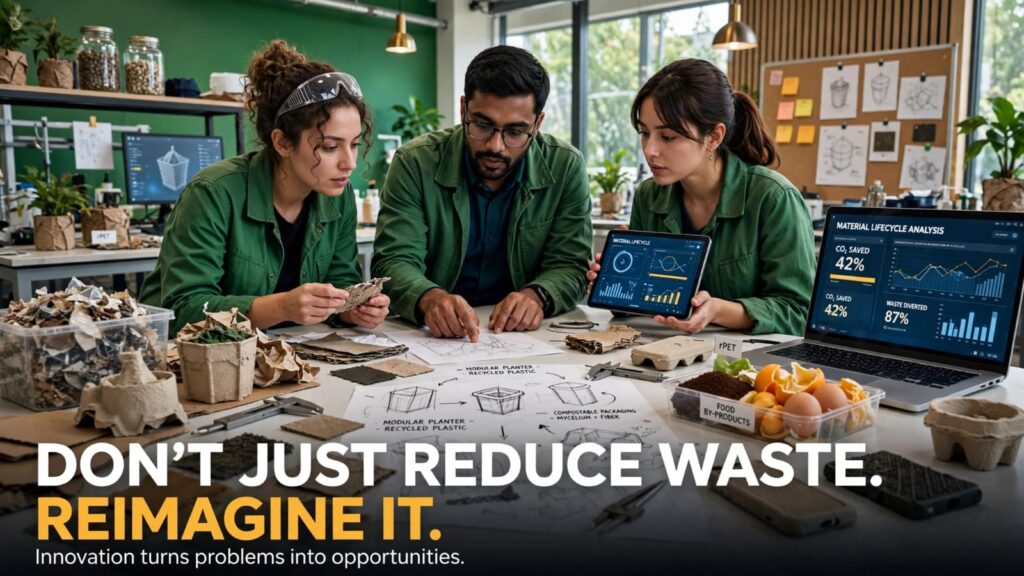
Sustainability requires businesses to think differently. Entrepreneurs can identify problems and turn them into opportunities. Imagine a company noticing that large amounts of coffee grounds are being thrown away by cafés. Instead of treating them as rubbish, the company could investigate ways to use them as compost or as an ingredient in other products. This is the power of innovation.
A sustainable business does not simply ask, “How can we reduce waste?” It also asks, “What can we create from the waste?”
This way of thinking can lead to new products, new services and even completely new industries.
Challenges for Sustainable Businesses
Although sustainable business offers many opportunities, it is not always easy.
One major challenge is high initial costs. New machinery, renewable energy systems and sustainable materials can require significant investment. Small businesses may find these costs particularly difficult to manage.
Another challenge is consumer behaviour. Even if a company offers sustainable alternatives, customers may choose cheaper or more convenient products. There can also be problems with the availability of sustainable raw materials. If demand increases rapidly, businesses may struggle to obtain enough recycled or environmentally friendly materials.
Finally, sustainability can involve difficult trade-offs. A material may be recyclable but expensive. Another may be cheaper but have a larger environmental impact.
Businesses therefore need to carefully consider both their financial and environmental objectives.
How Governments Can Help
Governments also have an important role to play. They can introduce laws and regulations that encourage businesses to reduce waste and pollution. Governments can also provide incentives such as grants or tax benefits for companies investing in renewable energy, recycling systems or environmentally friendly technology.
Another important method is education. If consumers understand the environmental impact of their purchases, they may be more likely to choose sustainable products.
When businesses, governments and consumers work together, sustainable practices can become much easier to implement.
Is Sustainability Good for Profit?
This is perhaps the biggest question. The answer is, “it can be”.
Sustainability does not automatically increase profits. A business could spend a large amount of money on environmental improvements without receiving an immediate financial return. However, sustainable practices can create several long-term benefits. Reducing waste can lower costs. Using less energy can reduce energy bills.
Creating sustainable products can attract customers. A strong environmental reputation can improve brand image. Innovation can create new products and markets. These factors can contribute to long-term profitability.
The most successful sustainable businesses are therefore not simply trying to “be green.” They are trying to find ways in which environmental responsibility and business success can support each other.
The Future of Sustainable Business
The future of business is likely to involve even greater emphasis on sustainability.
Natural resources are limited, waste is increasing and consumers are becoming more aware of environmental issues. Businesses that ignore these changes could face higher costs, stricter regulations and changing customer preferences. On the other hand, businesses that embrace sustainability can discover new opportunities.
The next generation of entrepreneurs may create businesses based entirely on solving environmental problems. They could develop new recycling technologies, create innovative sustainable materials, design products that produce less waste or discover new ways to reuse existing resources.
The possibilities are enormous.
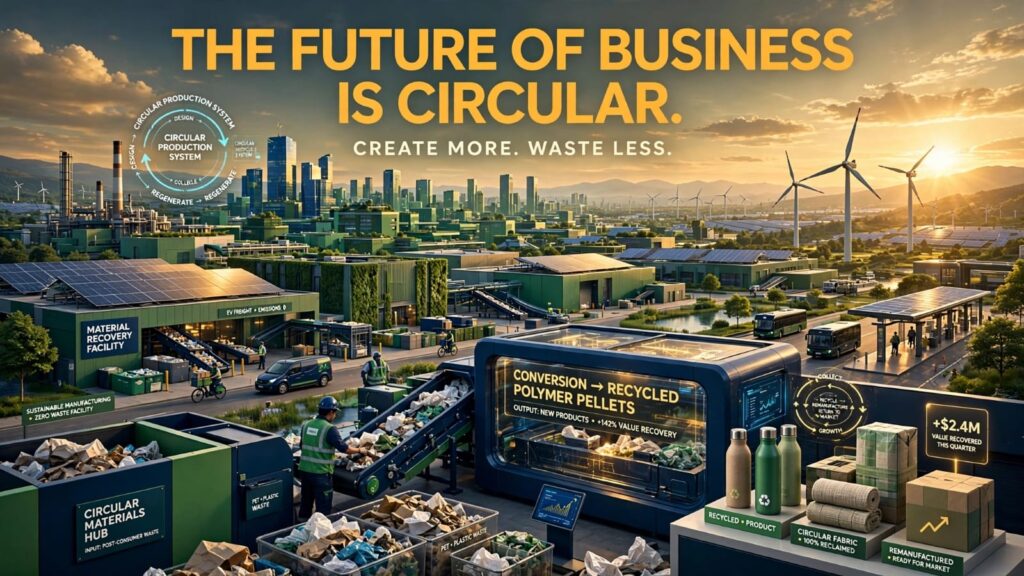
From Waste to Wealth
The journey from waste to wealth begins with a simple change in perspective.
Instead of seeing waste as something useless, businesses can see it as a resource waiting for a new purpose. A discarded material could become a new product. Unused food could become a valuable resource. Excess packaging could be redesigned. Energy waste could become cost savings. Environmental problems could become opportunities for innovation. Sustainable business is therefore not simply about protecting the planet. It is about creating a business model that can survive and succeed in the long term.
The phrase “From Waste to Wealth” represents a new way of thinking about business. It reminds us that economic success and environmental responsibility do not always have to compete. Sometimes, the biggest opportunity is hiding inside the biggest problem. Additionally, perhaps the businesses of tomorrow will be the ones that look at what everyone else throws away and ask one simple question,
“What could this become?”


Your blogs are very informative with core knowledge and I love to read this. It enhance my knowledge.
Thank you
Your blog is very informative. I got a glimpse of how businesses use waste products to get profits. Keep it up!! ♥️🌹
Thanks a ton