
Have you ever wondered how your favourite brands know what products you might want to buy? How does a streaming platform decide which shows to recommend? How can a sports team use statistics to improve its performance?How do businesses decide whether to launch a new product? Behind many of these decisions is something increasingly important, ‘business analytics’. In a world where almost everything produces data, businesses have access to every type of information. Every purchase, website visit, product review, search, social-media interaction and delivery can generate useful data. However data by itself is not very powerful.
The real value comes from understanding that data is used to make better decisions. This is where business analytics comes in.
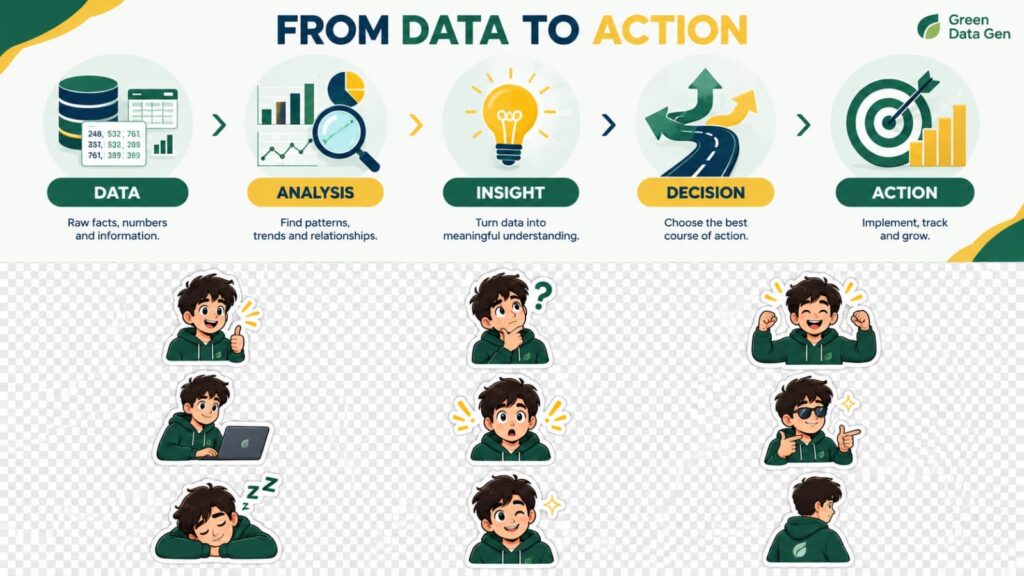
The Journey from Data to Decision
A simple way to understand business analytics is ,data is collected and analysed to generate insights, which support better decisions leading to an effective action.
Let’s imagine a fictional company called Green Shoes (GS), which sells environmentally friendly sneakers. GS collects information about its sales. The data shows that sales of one particular sneaker have increased popularity significantly among teenagers. The company analyses this information and discovers that customers are particularly interested in the sneaker’s recycled materials and sustainable design. This is now an ‘insight’. GreenStep could then decide to increase its production, improve plus invest in its sustainability marketing and launch similar type of products.
The data didn’t make the decision by itself. Instead, people used analytics to understand the data to make an applicable decision.
Putting Data to work
Method 1. Marketing: Understanding What Customers Want
Marketing is one of the most visible applications of business analytics. Companies want to understand their customers because knowing what people want can help businesses design better products and create more effective marketing campaigns.
Businesses can analyse information such as Website visits, Advertisement engagement, Product purchases, Customer reviews, Social-media interactions, Search behaviour, etc.
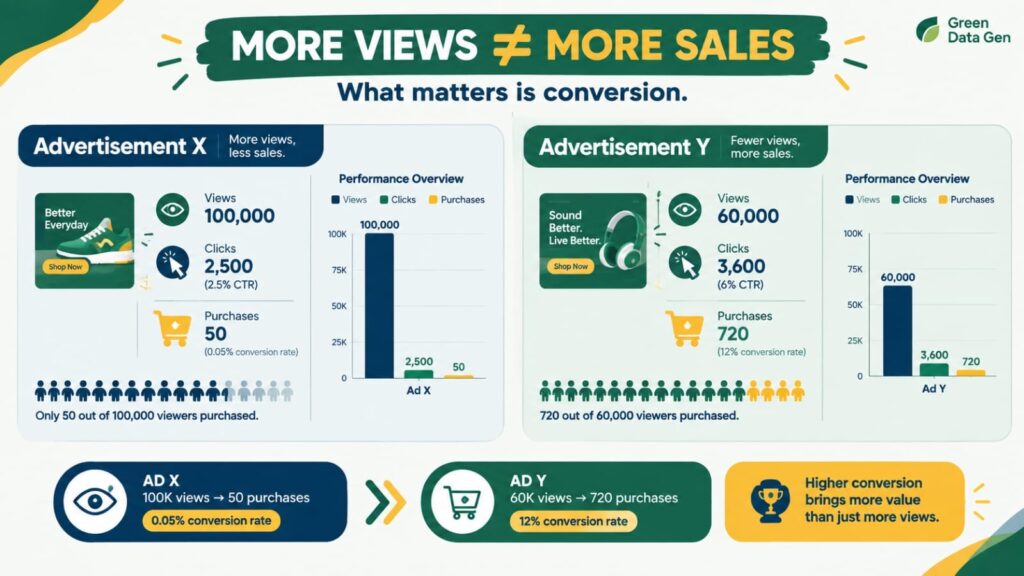
For example, imagine an online clothing company launches two advertisements. Advertisement X receives 100,000 views but only a small number of purchases.
Advertisement Y receives fewer views but generates significantly more purchases.
Simply looking at views might suggest that Advertisement A performed better. However, analytics tells a different story.
The company can calculate metrics such as ‘conversion rate’, which measures the percentage of people who take a desired action after seeing an advertisement.
This demonstrates an important lesson:
“More data does not mean better decisions. Businesses need to know which data matters”.
Method 2. Finance: Understanding Revenue, Costs and Profit
Business analytics is also extremely important in finance. Every business needs to understand its financial performance.
Companies can analyse the Revenue,Costs,Profit,Cash flows,Sales trends,Expenses,Financial forecasts
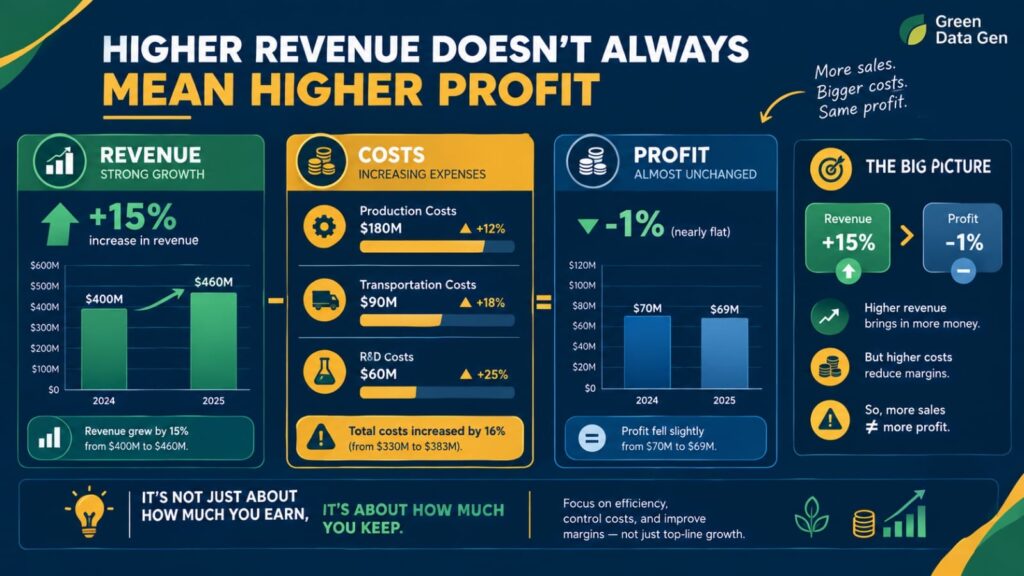
Let’s suppose a company notices that its revenue has increased by 15%, but its profit has barely changed.At first, this might seem surprising. Analytics can help managers investigate what happened. Perhaps production costs increased or maybe the transport costs became more expensive or the company spent significantly more on R&D(research and development).
By analysing different financial figures together, managers can identify the factors affecting profitability. This is particularly important because higher sales don’t always mean higher profits.
A business needs to understand the relationship between its revenue and its costs.
Method 3. Inventory : Deciding What Products to Stock
Walk into a supermarket and you’ll see thousands of products. But how does the supermarket decide how many products to order? Analytics plays a major role.
Retailers can analyse previous sales to identify patterns in customer demand.
For example, sales data might show that the cold drinks become more popular during hot weather, certain products sell more during festivals, some products sell particularly well on weekends, certain products are frequently purchased together, etc.
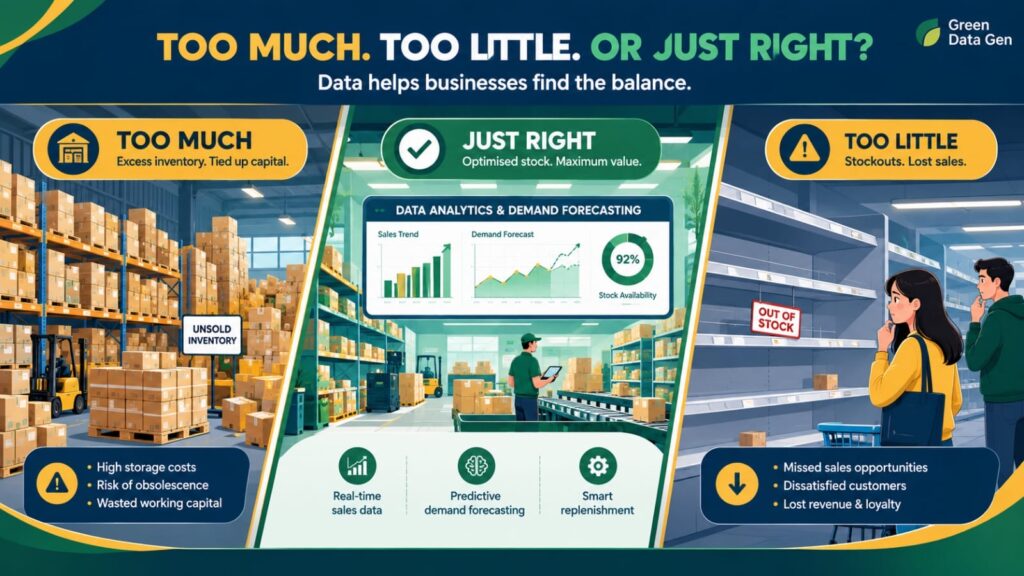
A retailer can use these insights to improve inventory management. If a company orders too much stock, products may remain unsold. If it orders too little, customers may find that the product is unavailable.
Therefore, analytics can help businesses find a better balance.
Method 4. Supply Chains: Getting Products to Customers
Have you ever ordered something online and wondered how it reaches your home so quickly? Behind the scenes is a complicated supply chain.
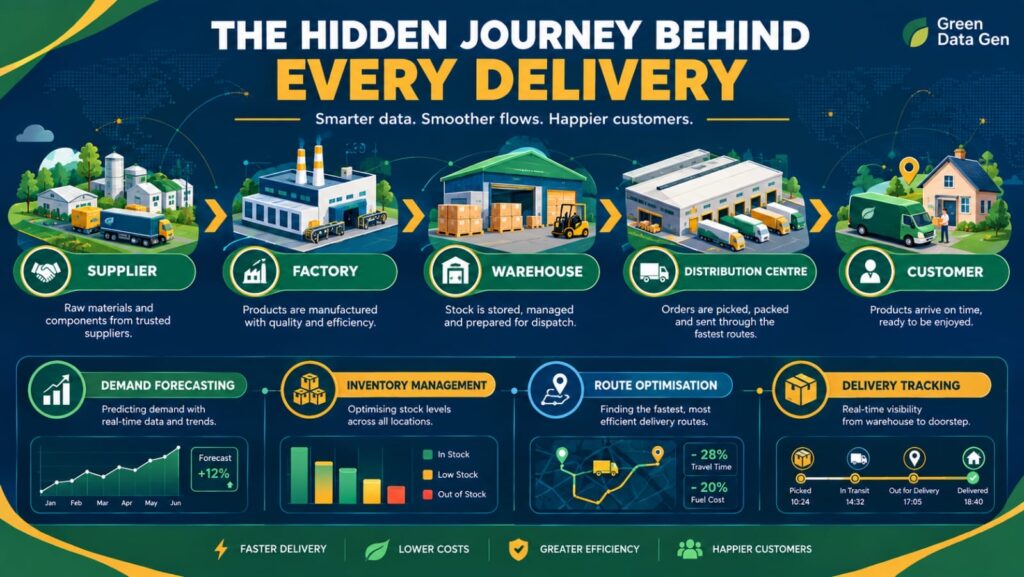
A supply chain can involve: Products moving from the supplier to the factory, then to the warehouse and distribution centre, before reaching the customer.
Businesses need to decide how much should they produce?, Where should products be stored?, When should new stock be ordered?, Which delivery routes are most efficient?, How can delays be reduced?
Analytics can help answer these questions.
For example, historical sales data might show that demand for a particular product usually increases before a major festival. A company can use this information to prepare additional inventory before demand rises.
This is an example of using data to anticipate future demand rather than simply reacting to it.
Method 5. Predictive Analytics: What Could Happen Next?
So far, we’ve mainly discussed understanding what has already happened.But analytics can also help businesses think about the future.
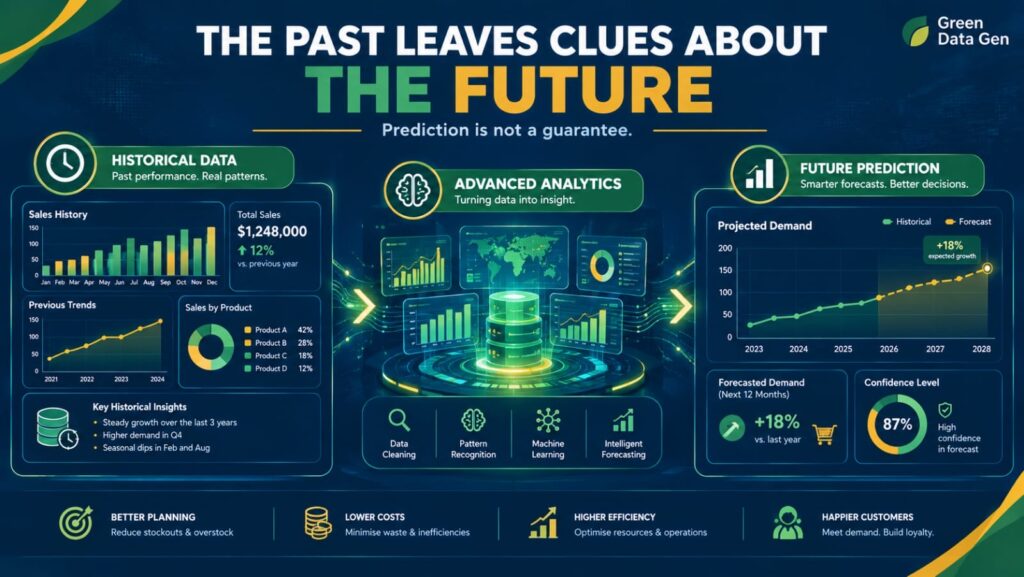
This is known as predictive analytics. Predictive analytics uses historical data, statistical methods and other information to estimate what might happen in the future.
For example, a business might analyse previous sales to forecast next month’s demand. A streaming platform might analyse viewing behaviour to predict which types of content a user may enjoy. A retailer could use previous purchasing patterns to anticipate future demand.
However, there is an important point to remember,
“A prediction is not a guarantee”.
Even sophisticated models can be affected by unexpected events.That’s why businesses need human judgement alongside analytics.
Method 6. Prescriptive Analytics: What Should We Do?
Analytics can go one step further. Prescriptive analytics focuses on possible actions and helps businesses decide what they should do.
Imagine a company predicts that demand for one product will increase next month.
The next question is, “What should we do about it?”
Should the company increase production?,Increase its advertising?,Raise or lower prices?,Order more materials?,Open additional distribution capacity?
Prescriptive analytics can help businesses evaluate different options.
This makes analytics more than simply looking at the past.
It can become a tool for planning and decision-making.
Method 7. Sustainability and ESG: Using Data for a Better Future
Business analytics isn’t only about making more money. It can also help companies understand their environmental and social impact. Businesses can collect and analyse information about,
1. Energy consumption
2. Carbon emissions
3. Water usage
4. Waste
5. Recycling
6. Resource efficiency
For example, a manufacturing company might analyse energy consumption across its factories. If one factory uses significantly more energy to produce the same amount of output, the company can investigate why. Analytics could help identify opportunities to reduce waste and improve efficiency. This is where business analytics, sustainability and ESG can come together. For younger generations especially, this is an exciting area because businesses increasingly need to consider not only financial performance, but also their impact on people and the planet.
How to start Thinking Like an Analyst?
You don’t need expensive software or advanced mathematics to start developing analytical thinking. The next time you see a statistic, advertisement, sports result or business story, ask yourself, “What does the data actually tell me?”
Then ask, “What doesn’t it tell me”? And finally, “What decision could someone make using this information?
This simple habit can help you start thinking like an analyst.
The Future Is Data Driven
Business analytics is changing the way organisations operate. Companies are no longer relying only on intuition or experience. They increasingly combine human judgement with data to understand customers, improve operations, forecast demand, manage finances and address sustainability challenges.
But the most important lesson is this,
“Business analytics isn’t about having the most data. It’s about asking the right questions and turning useful data into meaningful decisions”.
For the next generation, understanding data will be more than a technical skill. It will be a way of thinking. So the next time you see a company launch a product, change its strategy, run an advertisement or make a major decision, ask yourself,
“What data might be behind that decision?”
You may discover that there’s an entire analytical story hiding behind it.
And that is the real power of business analytics.


-
-
-
-
-
-
-
-
-
-
-
-
-
-
-
-
-
-
Show CommentsSo proud of you, my son! ❤️ It’s wonderful to see you exploring your ideas and creating something like GreenDataGen at such a young age. Keep learning, keep growing, and always believe in yourself. Wishing you lots of success! 🌱👏
Thank you
What an engaging blog.
Thank you
This blog explains business analytics in a clear and interesting way. I especially liked how it connects data with real-world decision-making and sustainability.
Thank you
I personally loved this idea. I always wanted to know more about businesses and data. This is the perfect place to get and give knowledge. And here the AI is not used unnecessarily and has been used where it is needed. Also this is a very fun way to learn.
I personally loved this idea. I always wanted to know more about businesses and data. This is the perfect place to get and give knowledge. And here the AI is not used unnecessarily and has been used where it is needed. Also this is a very fun way to learn…
Thank you
Really well written! 👏❤️
Great work, Suhan!! Keep learning, exploring, and sharing your knowledge. Really proud of you.!!
Wishing you lots of success ahead!! 🌱👏👏
Thank you
This blog explains business analytics in a clear and interesting way. I especially liked how it connects data with real-world decision-making and sustainability.It is a fantastic piece of work.Keep the good work Suhan
Thanks a lot
It is a fantastic piece of work.Keep the good work Suhan as you will achieve great achievemnts in life
Very informative and detailed explanation including all fundamentals of analytics
Thank you
Business analytics is nowadays very importent aspect for growing business .it connects business with IT. Your blog is very informative and focuses on key points..
Thank you